
The Power & Restraint of Creative Beings
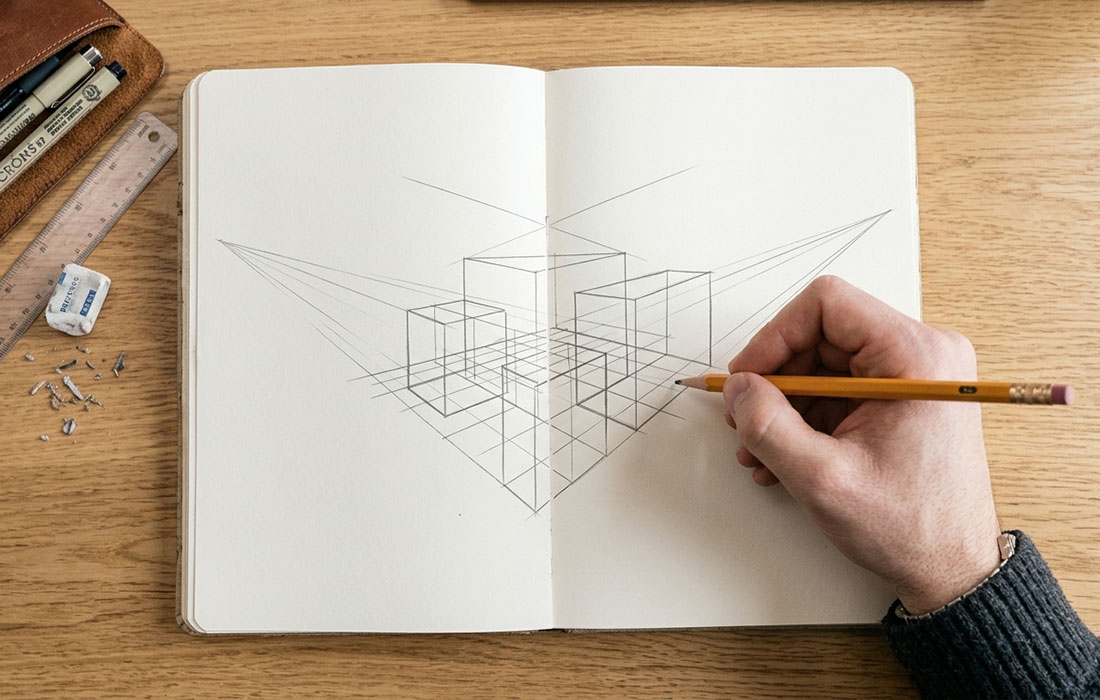
"In the beginning, God created." It's one of the simplest statements in the Bible, and it carries an extraordinary implication: God is, by nature, a creative being. The Bible then tells us that humanity was made in His image. I don't think that means we physically resemble Him, and it doesn't mean our minds work the way His does. God exists beyond the physical limits we understand, and His capacity for thought is beyond anything we can comprehend.
But part of what it means to be made in the image of God may be that we're creative beings, too. We have an impulse to make. We build, shape, design, organize, improve, and transform. We take something that exists only as an idea and try to give it form in the physical world, and there's something deeply satisfying about that. Maybe that desire isn't incidental to being human. Maybe it's part of the definition.
The Long Road from Thought to Thing
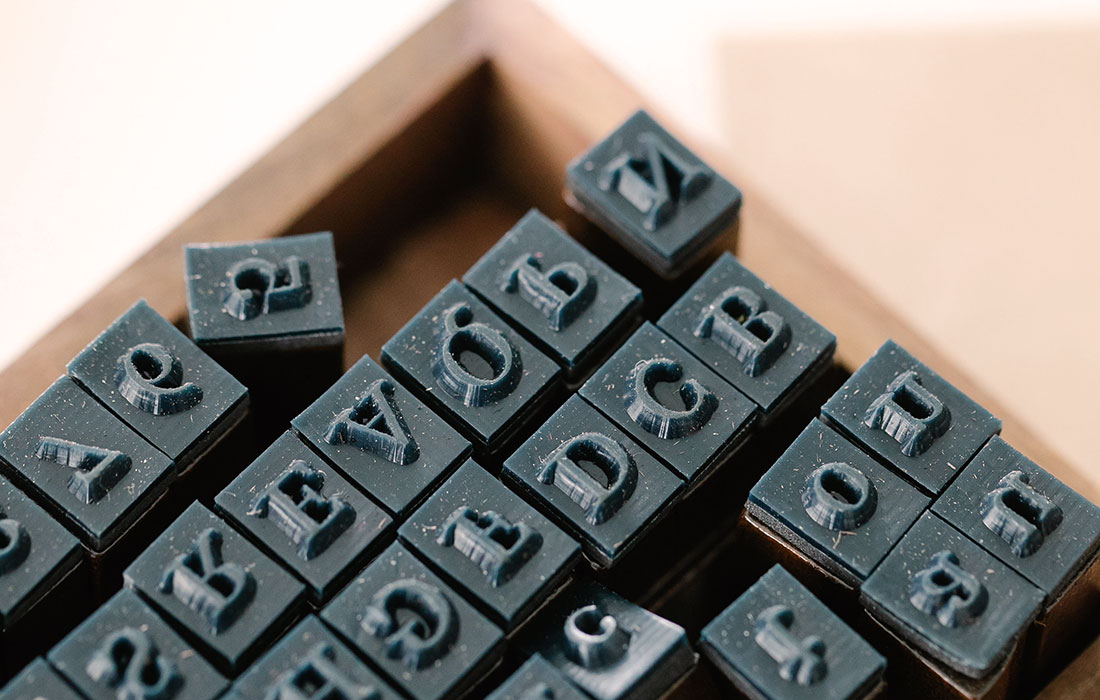
For most of human history, there was an enormous distance between having an idea and bringing it into existence. Take something as simple as writing. Before a thought could become a written work, somebody had to press it into clay, carve it into stone, paint it onto a surface, or write it out by hand. If it was going to reach a second person, somebody had to make a second copy. The idea existed in the mind right away. The physical artifact came much later.
Then the printing press showed up, and suddenly an idea could be committed to a page once and reproduced hundreds or thousands of times. The idea hadn't changed. The human desire to communicate hadn't changed. The distance between thought and reality had.
Every major tool since has done the same job: shrink the gap between having an idea and holding the finished thing. Machines let us manufacture objects with more speed and consistency, separating the conception of a thing from the labor of reproducing it. Photography let us capture a moment and copy it. Computers turned information into something we could manipulate, duplicate, and transmit almost instantly. With each step the gap got smaller, the process got faster, and the creative act opened up to more people.
Now software and AI have that distance down to seconds. You can have an idea in your head and almost immediately be looking at an image, a written passage, a design, a website, or a piece of music. Creating something with your mind is becoming almost literal. We're approaching an asymptote where ideation and existence sit so close together that the line between them is hard to see.
That should change the way we think about creativity, because it leaves one question no tool can answer for you.
The Pull of the Tools
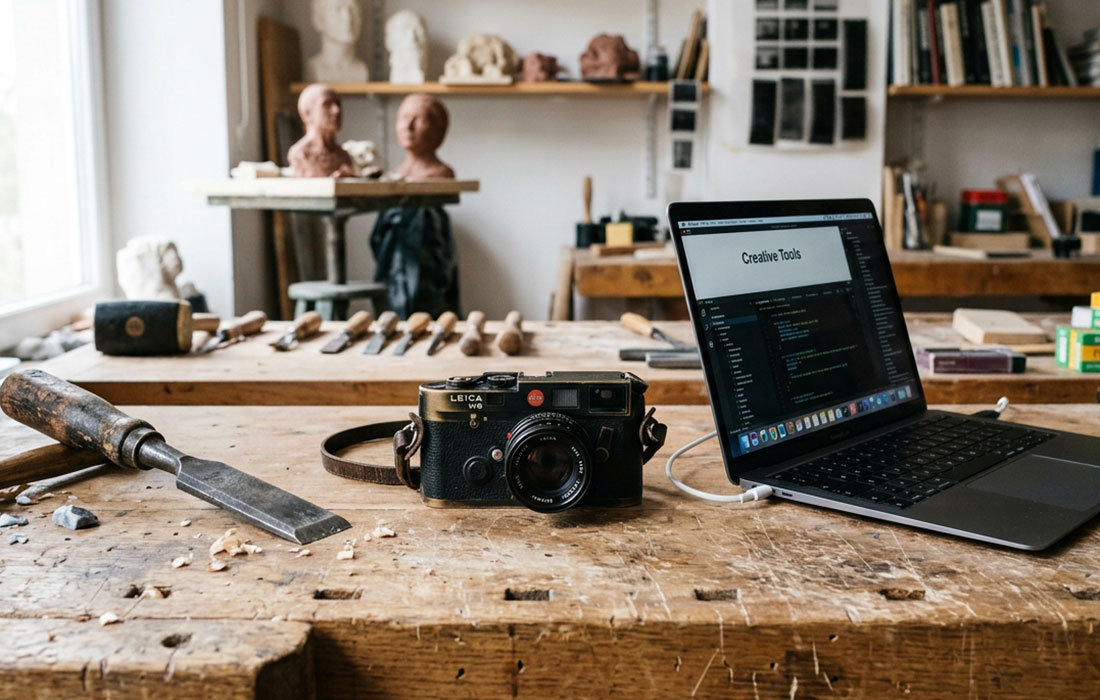
This also explains why we're so drawn to the tools of creativity. We want to own them, understand them, and become more capable through them, because there's real power in holding the means to turn an idea into reality. The chisel extended the sculptor's hand. The printing press extended the writer's voice. The camera extended the eye. The computer extended our capacity to work with information. AI extends something even more fundamental: our ability to translate intention into creation.
That power is exhilarating. It's also magnetic. It's easy to become fascinated with the act of creating instead of the thing being created, and to fall for the tools themselves—their novelty, their capabilities, and the sheer speed they give you.
This is where a distinction becomes necessary. Being able to make something doesn't mean you should make it. Fast doesn't make it valuable. Possible doesn't make it worthwhile. The greater our ability to create becomes, the more judgment has to grow alongside it.
The tools aren't the problem. AI, software, machines, factories, and cameras can all be extraordinary forces for good. But they ought to be used with caution, concern, elegance, beauty, and restraint. The power to create is not the same thing as the wisdom to create well.
Why I Don't Fear Design and Marketing Going Away
This is also why I don't fear design or marketing disappearing. If you look only at the final product, the worry makes sense. A logo can be generated. So can an advertisement, a website, an image, or an article. The artifact shows up almost instantly.
But the artifact has never been the whole creative process. Producing something and deciding to produce it are fundamentally different acts. My strength isn't simply production. It's the relationship between ideation and production.
The better the tools get, the less valuable it is to merely know how to operate them. What gets more valuable is the ability to determine what's worth making in the first place. Someone with bad ideas can now produce those ideas faster. Someone with good ideas can produce those faster, too. The tool doesn't know the difference. That still takes judgment.
My experience, my goals, and my drive behind every project come down to separating the good ideas from the bad ones, then producing the good ones faster and pushing the bad ones away. That's where much of the value of design and marketing actually lives—not merely in making things, but in deciding what deserves to be made.
Creators Ask "Can I?" Designers Ask "Should I?"
This reveals an important difference between designers and creators. Some people simply want to create. They're compelled to build something, make something, or try a new tool because the act itself is satisfying. There's nothing wrong with that impulse. It may be deeply connected to the creative nature we started with. But creation for its own sake isn't necessarily design.
Design begins with a problem. It requires empathy: understanding another person, understanding what they're trying to accomplish, and working out how something can serve them. A creator asks, "What can I make?" A designer also has to ask, "What should I make?"
That difference matters more as the barriers to production disappear. When making something was hard, the difficulty naturally limited what got made. Now that creation is nearly effortless, that limit is gone, and we can produce more things, more quickly, than at any point in history. So the question stops being "Can I make this?" and becomes a harder set:
- Should I make this?
- Who is this for?
- Does it help?
- Is this a good idea?
The tools have become extraordinarily powerful. But power doesn't eliminate the need for judgment. It makes judgment more important.
The Responsibility of Being Creative
If we really are created in the image of a creative God, then our desire to create isn't something to suppress. It's something to understand. We should build. We should invent. We should design and explore what's possible. But we should also recognize that the ability to create is a responsibility.
The trajectory is clear. What once took days of writing by hand now happens instantly. What once took a printing press can be published globally with a few keystrokes. What once took a specialized production facility can sometimes be done with software. The distance keeps shrinking, and as it shrinks, the value of thoughtful creation doesn't diminish. It increases.
When production is scarce, production itself is valuable. When production is abundant, discernment is valuable. When almost anyone can make almost anything, the hard question is no longer "How do I make it?" The hard question is "What should I make?"
Maybe that's where creativity has always been most meaningful—not simply in the ability to bring something into existence, but in having the wisdom to know what deserves to exist. To create is to exercise a remarkable power. To create well is to exercise judgment. And knowing what deserves to be created may be the highest expression of the creative act.